
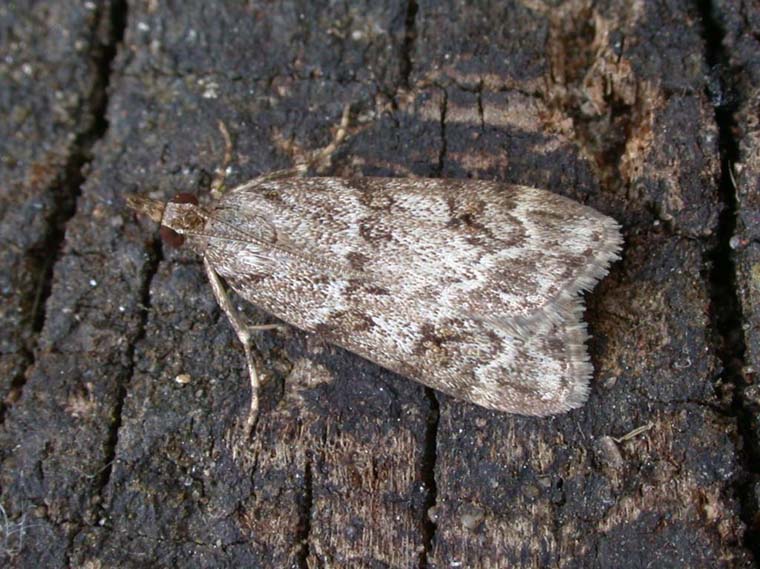
Scoparia ambigualis
63.064 BF1334
Wingspan 15-22 mm.
One of several very similar moths which can be rather difficult to separate.
The adults fly from May to July, and can be found resting on tree-trunks or rocks.
A common species throughout Britain, though until recently, the early stages have been undescribed.
Flight period
| Month | Records |
|---|---|
| January | 10 |
| February | 0 |
| March | 1 |
| April | 26 |
| May | 1,066 |
| June | 6,045 |
| July | 5,192 |
| August | 1,162 |
| September | 183 |
| October | 32 |
| November | 11 |
| December | 6 |
More details
Food: Moss and/or organic detritus under moss. On marshy ground, or near bracken. November, or earlier, to June.
Length: 13 mm.
Head: Mid brown with black posterior and anterior edges.
Prothoracic shield: Shiny dark brown.
Thorax: Segments T2 & T3 dark brown with large blackish pinacula (two on dorsum of each segment).
Thoracic legs: Dark brown and blackish.
Abdomen: Dark brown with indistinct grey gut showing dorsally. Greenish grey in May, June. Very large blackish pinacula (four on dorsum of each segment).
Spiracles: Black
Setae: Black at base, fading distally to colourless transparent.
Anal plate: Blackish with small reddish marks.
Prolegs: Dark brown at base. Planta whitish with small black spot. Double circle of grey-black crochets. Anal prolegs encased in long blackish pinaculum.
Similar Species: Larvae of several species of Scopariinae are similar, with very large pinacula. They should be reared to confirm identification. For a more detailed description, including chaetotaxy, of S. ambigualis see; Smith, I.F., (in press). A description of the larva of Scoparia ambigualis (Treitschke, 1829) (Lepidoptera: Pyralidae). Entomologist?s Gazette (publication due 2004).
Rearing: Keep in plastic box with transparent lid in North facing window. Provide sample of moss and organic material found with larva. Wash the moss and sterilize the detritus in a microwave. Wipe out condensation. Raising indoors will result in early emergence.